

How Driving a Used Car Could Retire You
This sounds like an exaggeration. It is not.
Let’s Start With a Number
The average new car in America now costs just under $50,000. The average used car costs around $25,000. That’s not a small difference; that’s a down payment on a house, college tuition, or several years of maxed-out retirement contributions.
And yet most people shopping for a car spend more time thinking about the color than about what that gap could do for their financial future.
The Original Idea
This isn’t a new concept. Ron Muhlenkamp (my grandpa and a value investor who spent decades watching how ordinary financial decisions compound over time) laid this out simply: buy used cars, fund your IRA every year, and let the math work. His own record backed it up. Over 32 years, his total depreciation cost across 24 cars was less than $20,000 for a two-car family. Meanwhile, his IRA—funded consistently since 1981 with no fancy strategy, just two solid no-load mutual funds—compounded at better than 12% annually.
The cars were cheap. The retirement account was not.
The insight is this: wealth isn’t usually built by one big dramatic move. It’s built by redirecting money that was going to disappear into depreciation and interest into something that compounds instead.
Let’s Be Honest About the Market Right Now
Used cars are not as cheap as they used to be—and pretending otherwise doesn’t help anyone.
The COVID years created a supply chain mess that the used car market is still working through. Leasing hit a low point in 2022, which means fewer quality off-lease vehicles have been coming back into the used market. The result: three-year-old used vehicles averaged around $31,500 in early 2026 — close to a record high for that segment.
Here’s the good news. Supply is coming back. A surge in off-lease returns is projected through the rest of 2026 and into 2027—hundreds of thousands of additional units hitting the market, which should bring more inventory and more competitive pricing, especially on certified pre-owned vehicles. Used EVs in particular are expected to represent strong value as that inventory builds.
And even in today’s elevated market, the gap between new and used is enormous. Tariffs have pushed new car prices up roughly 10% in the past year. Imported vehicles have seen increases of $5,000–$8,900 per vehicle. Domestic models aren’t immune either, given how much of their parts come from overseas. The new car market is getting more expensive faster than the used car market, which means the financial case for buying used is actually stronger right now, not weaker.
The timing just requires a little more patience and strategy than it used to.
The Math That Makes This Work
A brand-new car loses somewhere between 15–25% of its value in the first year. Just from being driven. You haven’t done anything wrong—that’s just what happens to new cars. By year three, a car that cost $45,000 new might be worth $28,000–$30,000.
That depreciation hit lands on whoever buys new. Which doesn’t have to be you.
A three- to five-year-old vehicle with low miles has already absorbed that steepest drop. You’re not buying someone’s problem; you’re buying a car that already proved it didn’t fall apart, at a price that reflects the reality of what it’s worth now.
There’s one more thing worth knowing: used car loans typically carry interest rates about 4 percentage points higher than new car financing, because lenders price in more risk on older vehicles. That’s real, and it’s worth factoring in. But the lower purchase price still more than compensates—especially if you can minimize the loan amount or avoid one entirely.
When you add up what you save on depreciation, interest, and insurance over the life of the car? The difference between driving new and driving used can easily be tens of thousands of dollars over time. What you do with that money is where it gets really interesting.
What the Redirect Actually Looks Like
The money you’re not spending on a new car has to go somewhere on purpose, or it disappears into life.
The IRA contribution limit is now $7,500 per year ($8,600 if you’re 50 or older). You don’t have to start there. Start with what’s real—even $2,000 or $3,000 a year, automated and consistent, does something significant over time. Here’s what the math looks like:
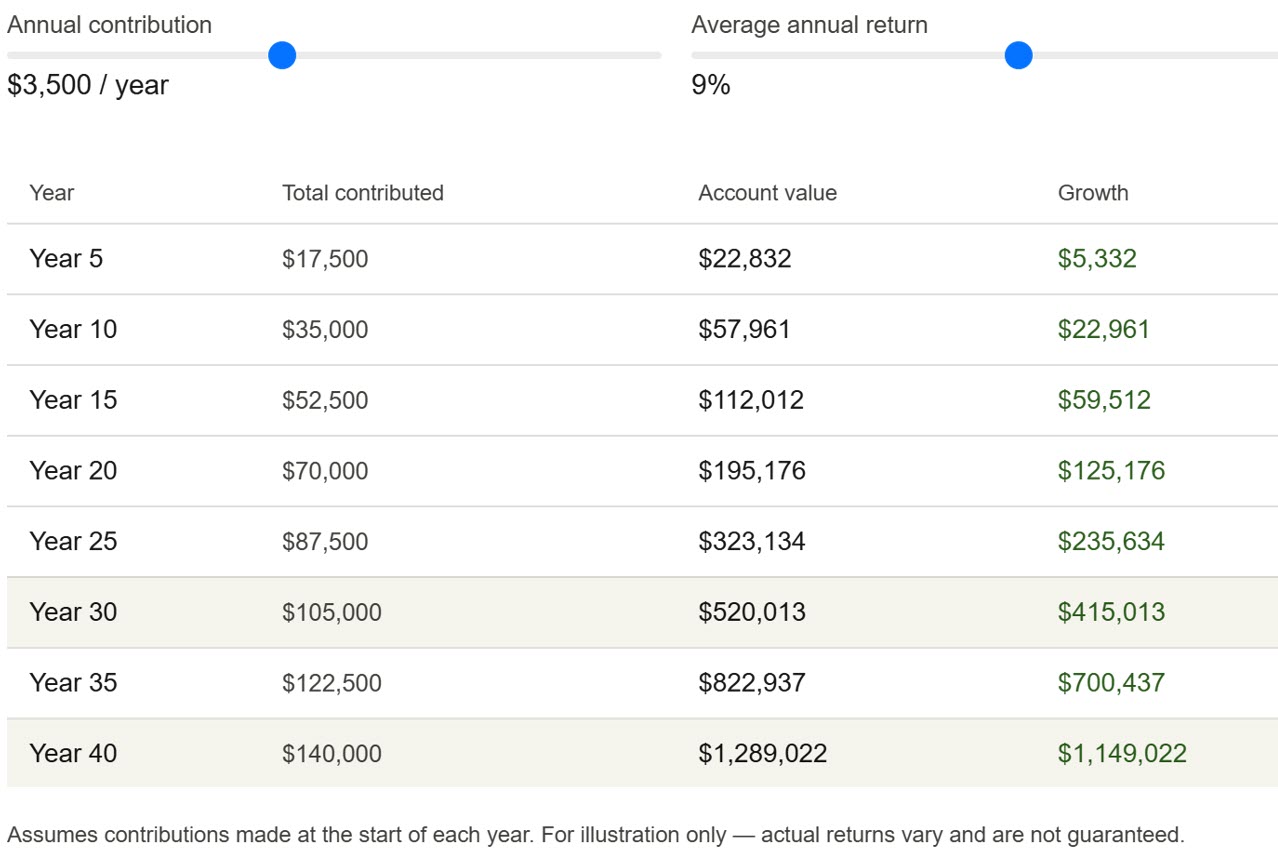
Set up an automatic contribution (Roth if you’re eligible, traditional if you need the deduction) on the same day every month. Don’t negotiate with yourself about it. It’s already spoken for. The car decision and the retirement decision are the same decision. You’re just making them at different times.
Three Things That Make This Strategy Work
Buy used and keep it. The sweet spot, especially as inventory improves through 2026 and 2027, is a three- to five-year-old certified pre-owned vehicle with low miles. Drive it for eight to ten years, and your annual cost of ownership drops dramatically compared to cycling through new cars every few years.
Skip or minimize the loan. Every dollar of interest you pay on a car loan is a dollar that isn’t compounding anywhere. If you can’t pay cash, finance the smallest amount possible at the lowest rate available, and get pre-approved through your own bank or credit union before you walk into any dealership.
Automate the redirect. This is the part that actually makes it work. The savings have to go somewhere with intention. An automatic IRA contribution that fires on payday doesn’t ask for your permission or your energy. It just runs.
This Is Not About Deprivation
Driving a used car is not a sacrifice. Most people genuinely cannot tell a three-year-old car from a new one. The car gets you where you’re going either way.
What changes is what happens to the money in the meantime.
The person who drives new their whole working life and the person who drives used and invests the difference can end up in completely different financial situations—not because one of them was smarter or worked harder, but because of one decision made repeatedly over time.
That’s the whole thing. It really is that simple.
This information is intended for informational and educational purposes only and is not individual investment or tax advice. Investing involves risk, principal loss is possible.
Please remember that I am not an investment advisor nor am I a portfolio manager, but I can introduce you to a few.



More information on how we treat your information is available in our Privacy Policy.