
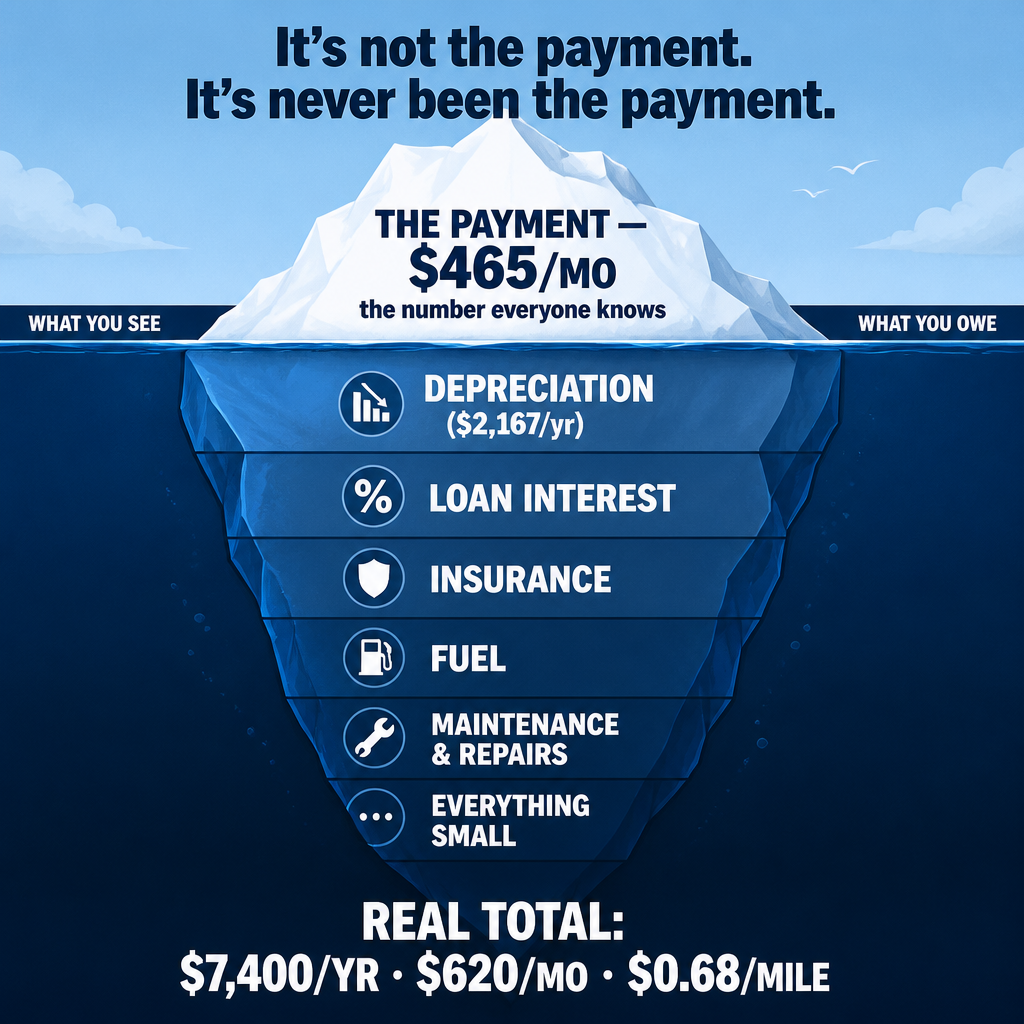
What Is Your Car Actually Costing You?
It’s not just the payment. It’s never been just the payment.
Ask most people what their car costs and they’ll tell you a number they know by heart. Four twenty-five a month. Six eighty. Zero, if it’s paid off.
That number is real. It’s just not the answer.
The payment is the piece someone else set up to be memorable — it shows up on the same day every month, it’s printed on the paperwork, it’s what you negotiated at the dealership. Everything else your car costs you arrives in pieces, at odd times, from different directions. Insurance in February. Tires in June. Registration whenever the envelope shows up. And the biggest cost of all never sends you a bill.
So let’s actually add it up. Not to make anyone feel bad — we’ll get to that part — but because most people have never once seen this number, and it’s genuinely useful to know.
The six things that make up the real number
Depreciation. This is the value that quietly left. If you bought a car for $27,500 three years ago and it’s worth $21,000 today, that’s $6,500 gone — about $2,167 a year — and you never wrote a check for it. You’ll only feel it on the day you sell or trade. For most people this is either the largest cost or the second largest, and it’s the one nobody counts.
Insurance. Whatever you pay in a year. If you’re looking at a six-month policy, double it.
Loan interest. Not your whole payment — most of that payment is principal, which converts cash into a car you still own. The interest is the part that buys you nothing. That’s the real cost.
Fuel or charging. Miles you drive, divided by your mileage, times what you pay at the pump.
Maintenance and repairs. Oil, brakes, tires, inspection, and the one surprise thing that happened last spring. Include the surprise. It’s not an outlier — there’s one every year, it just changes costumes.
Everything small. Registration, state inspection, personal property tax, tolls, parking, car washes. Individually forgettable. Collectively, not.
Add those six. That’s your number.
What it looks like when you actually run it
A 2021 RAV4, bought used in 2023 for $27,500. Still owes $12,400 at 8.9%. Drives 11,000 miles a year. The payment is $465 a month, so this person would tell you their car costs about $5,600 a year.
Run all six pieces and it’s a little over $7,400.
Not because they did anything wrong — this is a reasonable car bought at a reasonable price by someone being careful. The gap is just what’s always there and never counted. About $1,850 a year of real money that never appears in anyone’s mental math.
The three numbers worth writing down
Per year. The whole thing. This is the honest one.
Per month. Total divided by twelve. In the example above, that’s $620 — against a $465 payment. It’s the number that makes the gap feel real, because it’s in the same units as the number you already had in your head.
Per mile. Total divided by how far the car actually took you. The RAV4 comes out around $0.68 a mile.
That last one is where it gets interesting, because it’s the only number that accounts for how much you actually use the thing. Someone paying $9,000 a year to drive 4,000 miles is spending well over $2 every mile — and they’d probably never describe their car as expensive, because their payment is low and their car is old. The cost is fine. The use is what’s off. That’s a different problem with different solutions, and you can’t see it until you divide.
Your number is going to be higher than you thought
That’s the normal outcome. Not the exception — the outcome.
And here’s the part that matters more than the arithmetic: almost all of it was decided on the day you signed. The purchase price set your depreciation. The loan set your interest. The vehicle you chose set your insurance tier and your fuel bill. You made those calls with the information and the options you had at the time, and running the numbers now doesn’t give you a time machine.
So the number is not a report card. Nobody needs to feel bad about a car they already own. Feeling bad about it doesn’t return a single dollar.
What the number is for is the next decision. The insurance renewal that’s coming. The trade-in you’ve been idly considering. The car after this one. You’re going to make those calls anyway — the only question is whether you make them knowing your real baseline or your imaginary one.
What still moves
Two things, mostly.
Your insurance. Most people have not re-quoted in years, and rates drift. Fifteen to twenty minutes of comparison shopping is the rare financial move with no downside and no lifestyle cost — you keep the same car, the same coverage, the same everything. In the RAV4 example, a 15% improvement is about $250 a year.
Not replacing it yet. This is the big one, and it’s the same idea from the other direction. A car you already own has already taken its steepest depreciation. A newer one hasn’t. If that RAV4 driver swapped into a $38,000 vehicle, the depreciation alone would run roughly $2,000 more per year — before the higher insurance, the higher registration, and the new loan. Keeping a car that still works is not settling. It’s the highest-return decision available to most drivers, and it costs you nothing but the itch.
Together, those two moves are somewhere near $185 a month in that example. Which sounds small, until you notice it’s the same range of money we’ve been talking about all along — and that it only becomes anything at all if it has somewhere to go. Money you free up and don’t assign gets absorbed into ordinary life within about two months. That’s not a character flaw, it’s just how unassigned money behaves.
So assign it. Same day every month, automatic, before you can have an opinion about it.
The point
You can’t change what your car has cost you. You can absolutely change what the next one does.
But you can’t do either one until you know the number. And ten minutes with a calculator is a strange, small price for finding out something this many people drive their whole lives without ever learning.
This information is intended for informational and educational purposes only and is not individual investment or tax advice. Investing involves risk, principal loss is possible.
Please remember that I am not an investment advisor nor am I a portfolio manager, but I can introduce you to a few.




More information on how we treat your information is available in our Privacy Policy.